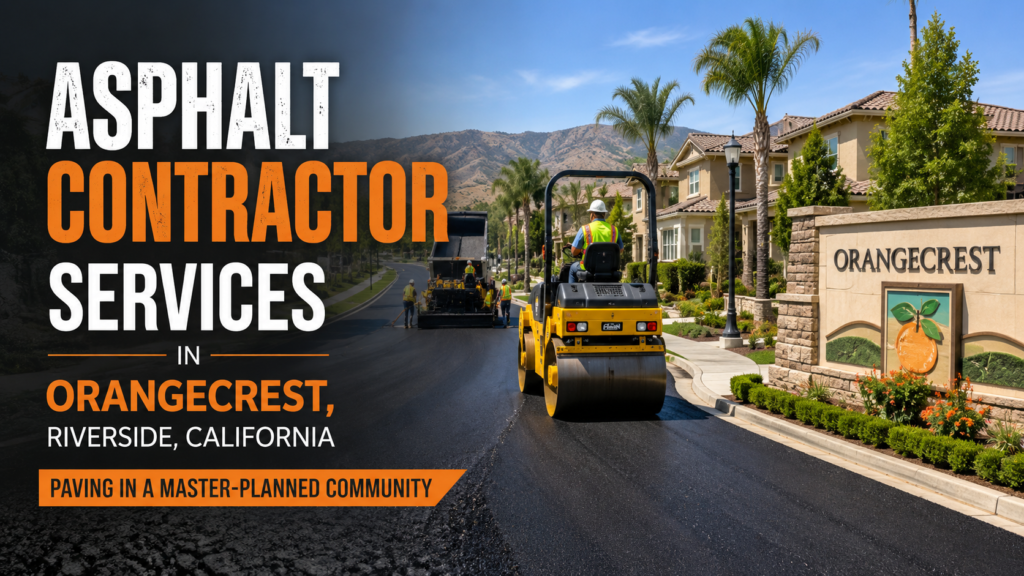
Orangecrest is one of Riverside’s newer, master-planned residential communities a neighborhood developed primarily in the 1980s and 1990s in the southeastern portion of the city, approximately ten miles from downtown Riverside. Built on land with a history reaching back to Riverside’s citrus farming era, Orangecrest was designed as a suburban community with consistent infrastructure standards, significant park space, and a planned street network. The neighborhood’s predominantly owner-occupied, single-family homes and well-maintained community character create a specific context for asphalt paving services: properties where homeowners take visible pride in maintenance, where the community’s planned character creates consistent lot sizes and driveway configurations, and where the Southern California climate steadily ages every paved surface through UV exposure and thermal cycling.
Orangecrest’s Paving Environment
Orangecrest sits on the Ramona series sandy loam that characterizes much of southeastern Riverside. This soil type well-drained, with pH in the 6.0 to 7.5 range provides relatively favorable sub-grade conditions for pavement construction compared to the clay-heavy soils of some other California regions. A standard 3 to 4 inch Class II aggregate base is appropriate for most residential paving in Orangecrest, with drainage that the sandy loam supports naturally.
The neighborhood’s climate mirrors that of the broader Inland Empire: hot, dry summers with temperatures regularly above 100 degrees Fahrenheit, mild winters that rarely see frost, and annual rainfall of approximately 10 to 12 inches concentrated in winter months. This climate means that UV oxidation not freeze-thaw damage is the primary aging mechanism for asphalt in Orangecrest. The intense sun characteristic of Riverside’s 280+ annual sunny days continuously attacks asphalt binder, causing it to oxidize, harden, and develop surface cracks that progressively worsen if not addressed through sealcoating and maintenance.
Residential Driveway Paving in Orangecrest
Orangecrest was built with a level of planning consistency that creates relatively uniform residential lot configurations a characteristic that makes driveway paving projects here more predictable than in older, less planned neighborhoods. Driveways in Orangecrest are typically medium length, with moderate grades from street to garage level, and the standard lot layout provides adequate access for paving equipment.
As the neighborhood reaches 30 to 40 years of age, many of the original driveways installed during the community’s development phase are reaching the end of their service life. Asphalt surfaces installed in the 1980s and 1990s that received adequate maintenance may still be in resurfaceable condition; those that were not maintained will likely require full replacement. The key distinction is the condition of the base if the aggregate base remains structurally sound and well-drained, resurfacing with a 1.5 to 2 inch overlay of new asphalt is appropriate. If the base has been compromised by water infiltration or vehicle loading, full-depth replacement is required.
Community Standards and HOA Considerations in Orangecrest
Many Orangecrest properties are subject to homeowner association (HOA) requirements that govern the appearance and maintenance of property surfaces including driveways. While specific HOA requirements vary, property owners planning driveway paving or resurfacing projects in Orangecrest should:
- Review HOA covenants, conditions, and restrictions (CC&Rs) for any requirements regarding driveway surface materials, colors, or maintenance standards.
- Confirm whether HOA approval is required before beginning paving work.
- Understand any requirements regarding contractor licensing and insurance that the HOA may impose for work within the community.
Experienced Asphalt Contractor Orangecrest working in master-planned communities like Orangecrest are familiar with these considerations and can assist property owners in understanding any HOA requirements that affect their paving project.
Commercial and Institutional Asphalt in the Orangecrest Area
Beyond residential driveways, the Orangecrest area includes commercial centers, schools, religious facilities, and other institutional properties whose parking lots and access roads require professional asphalt maintenance. In Southern California’s climate, commercial parking lots face all the same UV and thermal challenges as residential driveways but at greater scale and with the additional wear from regular vehicle traffic and the loading from delivery trucks.
Commercial properties near Orangecrest should follow a structured pavement management program:
- Annual inspection to assess surface condition, identify new cracks, and determine appropriate treatment.
- Crack filling every 1 to 2 years as needed to prevent water infiltration and surface deterioration.
- Sealcoating every 2 to 3 years to protect against UV oxidation.
- Overlay resurfacing when the surface has deteriorated to the point where maintenance treatments alone cannot restore adequate function.
- ADA compliance review with any restriping or resurfacing project, confirming that accessible parking meets current requirements for number, dimensions, and markings.
The Importance of Proper Sealcoating Timing in Southern California
Sealcoating in Southern California can be applied during almost any month of the year given the mild winters but timing within the season still matters for optimal results. The best conditions for sealcoating in Orangecrest are moderate temperatures (between 50 and 90 degrees Fahrenheit), low humidity, and a dry period forecast of at least 24 hours after application. Extremely hot days during Riverside’s summer should be avoided temperatures above 90 degrees can cause sealcoat to dry too quickly, preventing proper surface penetration and reducing adhesion.
After sealcoating, restriping should be performed promptly typically within 24 hours of sealcoat cure to restore parking space markings, ADA accessible spaces, and fire lane designations that were covered by the sealcoating application. Allowing traffic onto the lot before restriping allows use patterns to develop that may not align with the intended layout, creating confusion and potentially creating ADA compliance problems.
Conclusion
Asphalt contractors serving Orangecrest operate in a master-planned community environment where the neighborhood’s relative consistency of infrastructure age and lot configuration makes the typical paving project more predictable than in older or less planned neighborhoods. At the same time, Southern California’s UV-intensive climate and the Inland Empire’s summer heat create maintenance needs that are distinct from what Eastern or Northern California property owners experience. Understanding these conditions and the role that regular sealcoating and maintenance play in extending asphalt service life is the foundation of effective pavement management in Orangecrest.